




 Date: 2026-3-12 Click:220 times
The Century-Long Showdown Between Fish Oil and Algal Oil: How to Choose Your Omega-3 Supplement? — An In-Depth Analysis Based on Source, Absorption Rate, and Sustainability
In the Omega-3 supplement market, a debate over “origin” has never ceased.
On one side stands the traditional giant that has dominated the market for decades—fish oil. On the other is the emerging eco-friendly contender that has surged in popularity in recent years—algae oil. For consumers faced with shelves overflowing with “deep-sea fish oil” and “Chlorella algae oil,” how should they make their choice? Which is better suited for themselves and their families?
As a source manufacturer deeply rooted in the nutritional supplement field, we will cut through the confusion by examining four dimensions: raw material traceability, molecular structure, environmental sustainability, and suitability for different demographics. This provides a clear guide for your selection.
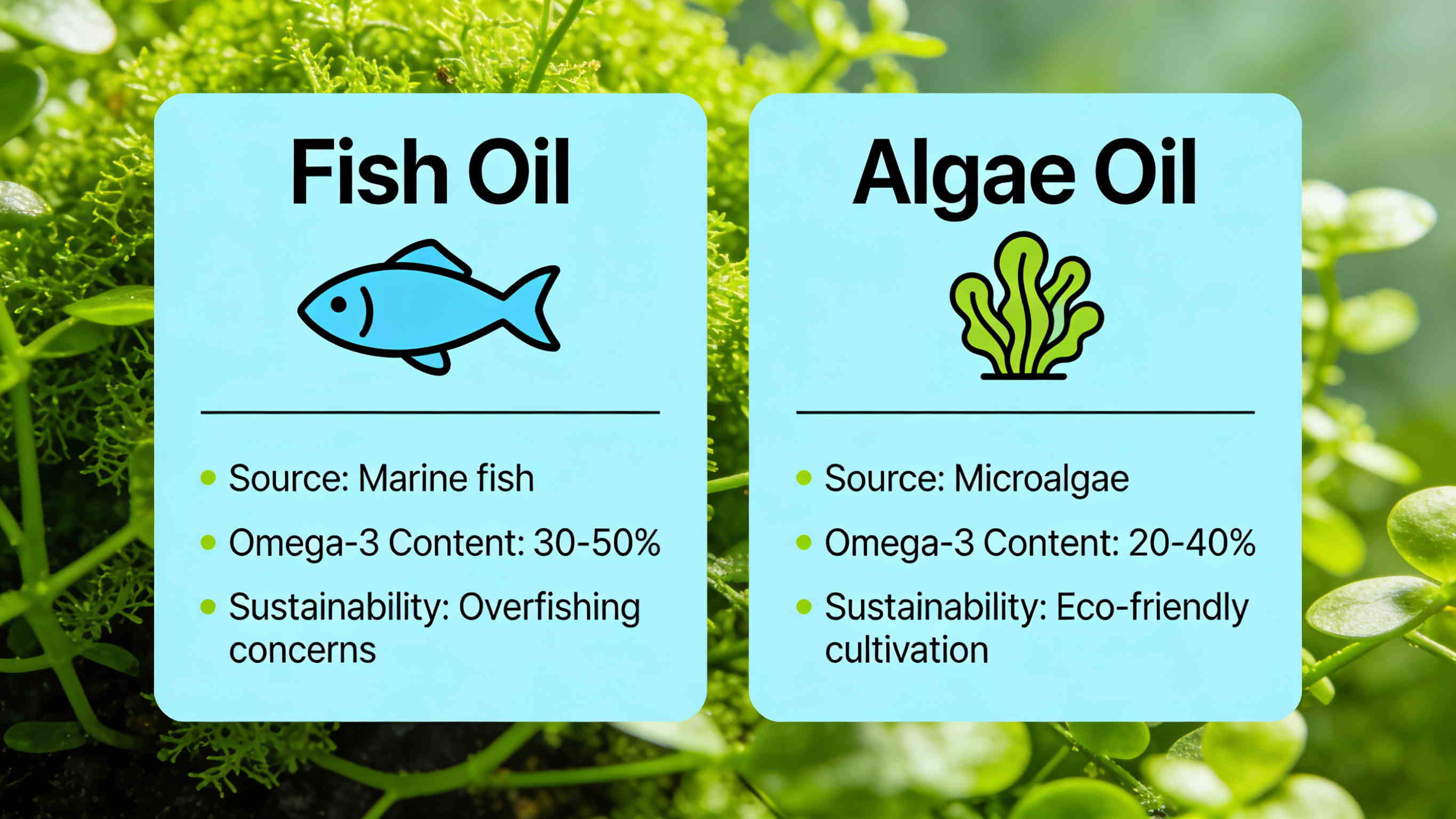
I. The Origin Debate: Big Fish Eat Little Fish, or “Self-Sufficiency”?
To understand the difference between fish oil and algae oil, we must first clarify where Omega-3 comes from.
Fish Oil: This represents a classic “bioaccumulation” process. Fish (especially deep-sea species like salmon and anchovies) cannot synthesize DHA and EPA themselves. Instead, they accumulate these fatty acids by consuming microalgae and plankton. Thus, fish oil acts as an “intermediary” for Omega-3.
Risk factor: As upper-tier organisms in the food chain, fish readily accumulate marine pollutants like heavy metals (mercury, lead) and polychlorinated biphenyls (PCBs). While rigorous molecular distillation can remove these impurities, it inevitably increases purification costs.
Algal Oil: Algal oil bypasses fish entirely, cultivating microalgae directly at the source. These algae (e.g., Schizochytrium, Cryptococcus) are the true primary producers of Omega-3.
Advantages: Microalgae cultivated in closed fermentation tanks are completely isolated from marine pollution, achieving clean production with zero marine contaminants. This is the core reason for algal oil's rapid popularity among infants, young children, and pregnant women.
II. Composition and Structure: The “Balancing Act” of DHA and EPA
Though both are rich in Omega-3, their specific composition profiles differ significantly.
1. Fish Oil: The Golden Duo of EPA and DHA
Traditional fish oil typically contains both eicosapentaenoic acid (EPA) and docosahexaenoic acid (DHA), often with a higher EPA content.
Functional Focus: EPA acts as an “anti-inflammatory messenger” in the body, playing a significant role in maintaining cardiovascular health, regulating blood lipids, and suppressing inflammatory responses.
Target Audience: More suitable for middle-aged and elderly individuals, those with elevated blood lipids, and athletes requiring anti-inflammatory support.
2. Algal Oil: DHA's Solo Performance
Algal oil boasts exceptionally high DHA concentrations, typically comprising 40%-50% of total fatty acids, while containing minimal EPA.
Key Benefits: DHA is a core component of the cerebral cortex and retinal photoreceptor cells, earning it the title “brain gold.” It is crucial for infant cognitive and visual development, adult memory maintenance, and preventing cognitive decline in the elderly.
Ideal for: Pregnant women, nursing mothers, infants, students, and office workers experiencing mental fatigue.
Special Note: For simultaneous anti-inflammatory and cardiovascular protection, EPA-rich fish oil is preferred. For prenatal supplementation or brain-specific nutrition, high-purity algae oil offers superior benefits.
III. The Secret to Absorption: Form Determines Effectiveness
Simply checking the DHA/EPA content on the label is insufficient. Absorption rate is the key factor determining a supplement's efficacy.
Omega-3 supplements on the market primarily exist in two forms: natural triglyceride (TG) form and synthetic ethyl ester (EE) form.
The Complexity of Fish Oil: To enhance concentration, many fish oil brands convert naturally occurring TG to EE to boost DHA/EPA levels per capsule. However, the human body absorbs EE far less efficiently than TG, especially on an empty stomach.
The Algal Oil Advantage: Most premium algal oils naturally occur in TG form. This means algae oil requires no complex re-esterification process, allowing direct and efficient absorption by the body.
Manufacturer's Recommendation: When selecting fish oil, always check product labels and prioritize options labeled “rTG” (re-esterified triglyceride) or “natural triglyceride.” Choosing algae oil typically means you're directly opting for the highly absorbable TG form.
IV. Purity and Sensory Experience: Veganism and “Fishy Odor”
This is an often-overlooked yet critical decision point.
Reflux and Fishy Taste: Some consumers experience “fishy burps” after taking fish oil, typically due to excessive oxidation levels or the indigestible EE structure. Additionally, inconsistent fish sources can make fishy taste unavoidable.
Vegan-Friendly: Algal oil is a purely plant-based source, completely free of fish components, making it perfectly suited for vegans and those with religious dietary restrictions.
Pure Taste: High-quality algal oil, produced in clean environments and free of fish-derived proteins, offers superior oxidative stability. It has virtually no fishy taste, resulting in a fresher flavor profile that is more readily accepted by taste-sensitive groups like pregnant women and children.
V. From a Manufacturing Perspective: How to Select Precisely Based on Needs?
As a responsible source manufacturer, we never blindly promote any single ingredient when providing OEM customization services. We advise partners to make the most scientifically sound decisions based on their target audience profiles:
|
Dimension |
Fish Oil Selection |
Algal Oil Selection |
|
Target Audience |
Middle-aged and elderly, cardiovascular health maintenance, fitness and anti-inflammatory |
Pregnant women, infants and young children, students, vegetarians, individuals with high mental exertion |
|
Core Benefits |
Lower blood lipids, protect heart and brain, anti-inflammatory |
Brain support, eye protection, purity and safety, no fishy taste |
|
Key Metrics |
EPA content, rTG formulation, IFOS certification (oxidation value) |
DHA purity, TG natural structure, non-GMO algae strain |
Conclusion: Fish oil and algae oil are not substitutes but complementary.
In household health supplementation, each serves distinct purposes: High-EPA fish oil for seniors' heart health, and high-DHA algae oil for prenatal and infant brain development.
Guangzhou Changshengkang Biotechnology Co., Ltd. consistently adheres to an “evidence-based science” R&D philosophy. Leveraging a global top-tier raw material supply chain (such as DSM's life's DHA® and Norwegian Klausen fish oil), we provide one-stop solutions from raw material traceability and customized formulations to finished product manufacturing. In this era of ingredient transparency, only products that truly understand science and prioritize purity can earn the long-term trust of end consumers.
About Guangzhou Changshengkang Biotechnology Co., Ltd.
With 18 years of contract manufacturing experience and a Class 100,000 GMP cleanroom facility, we hold multiple international certifications including FDA, GMP, HACCP, and ISO9001. We are not just manufacturers—we serve as your strategic advisor for comprehensive Omega-3 product lines. We welcome brand partners to visit our facilities and discuss OEM/ODM customization collaborations.